

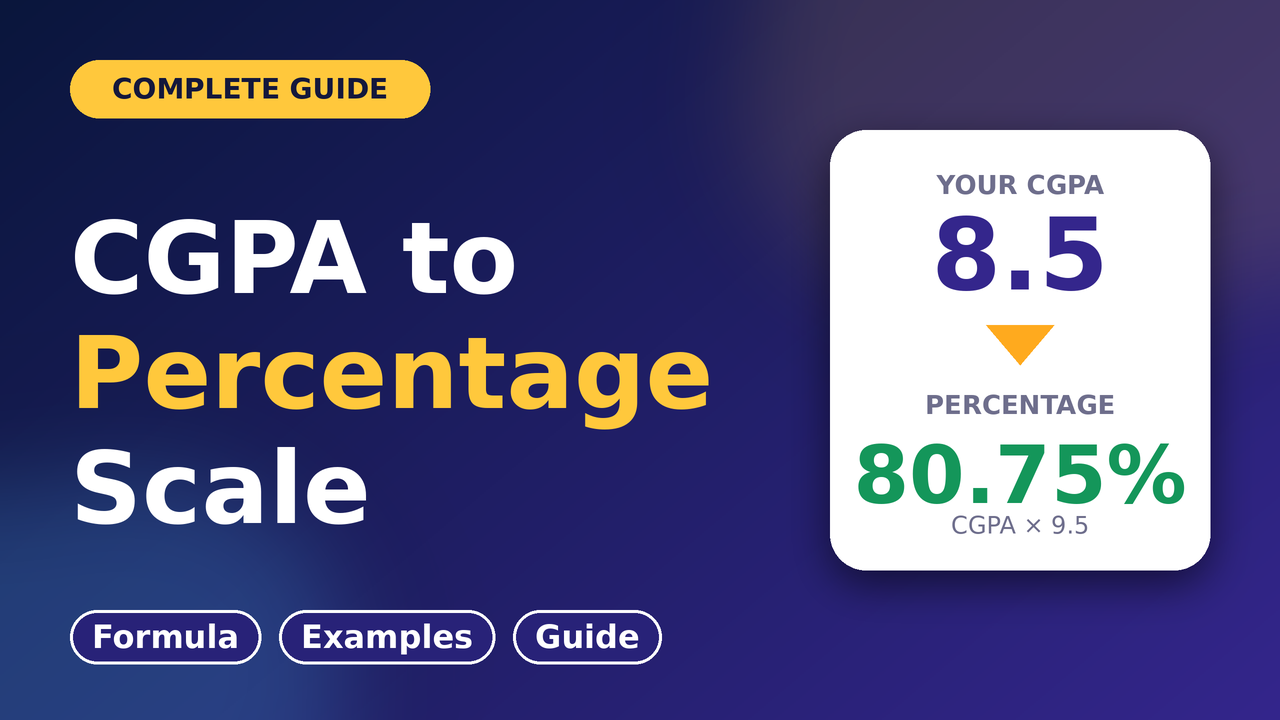
Understanding CGPA to Percentage Scale
The CGPA to Percentage Scale is a method for expressing cumulative academic performance as a percentage. CGPA stands for Cumulative Grade Point Average and combines grade points earned across courses or semesters. Percentage, in contrast, expresses academic performance on a scale of 0 to 100, making results familiar and easy to understand.
A CGPA does not automatically have one universal percentage equivalent. Universities and educational boards may use different grading systems, conversion factors, or official tables. Therefore, students should first identify their institution’s grading policy before calculating a percentage. This ensures the converted result is appropriate for admissions, scholarships, employment, or other purposes.
- CGPA means Cumulative Grade Point Average.
- Percentage is usually measured out of 100.
- CGPA summarizes cumulative performance.
- Conversion changes the reporting format.
- Institutions may use different formulas.
- Grading systems vary internationally.
- Official policies should be checked.
- Accurate conversion prevents reporting errors.
Why Is CGPA Converted Into Percentage?
Students may need to convert CGPA into percentage when an organization specifically requests percentage marks. University admission forms, scholarship applications, job applications, internships, and professional programs may use percentage-based eligibility requirements. Converting the result allows students to provide academic information in the format requested by the organization.
The conversion can also make academic records easier for people who are unfamiliar with a particular grading system. However, the percentage should not be treated as a new academic result. It is simply another way of expressing the original performance, based on an accepted conversion method.
- Helps complete admission forms.
- Supports scholarship applications.
- Useful for employment applications.
- Helps with internship requirements.
- Supports academic eligibility checks.
- Simplifies result interpretation.
- Makes reporting more flexible.
- Provides an alternative result format.
CGPA to Percentage Formula
A commonly used proportional formula is Percentage = (CGPA ÷ Maximum CGPA) × 100. For example, if a student has a CGPA of 3.2 on a 4.0 scale, the calculation is 3.2 ÷ 4.0 × 100, resulting in 80%. This method is useful when proportional conversion is officially permitted.
Some institutions use a specific conversion factor instead. For example, if an institution officially states that percentage equals CGPA × 9.5, a CGPA of 8.0 would produce 76%. These examples demonstrate why students should always check the applicable academic conversion rule before submitting a percentage.
- Identify the CGPA.
- Identify the maximum CGPA.
- Check the official formula.
- Use the correct conversion factor.
- Calculate carefully.
- Avoid mixing formulas.
- Keep decimal places accurate.
- Verify the final result.
CGPA to Percentage for 4.0, 5.0, and 10.0 Scales
Different institutions use different CGPA systems. The 4.0 scale is widely recognized, while 5.0 and 10.0 systems are also used in various educational settings. The maximum CGPA is important because it determines how a student’s numerical result should be interpreted.
For example, using proportional conversion, 3.0 out of 4.0 equals 75%, while 4.0 out of 5.0 equals 80%. Similarly, 8.0 out of 10.0 equals 80%. These are mathematical examples only; an institution may require a different official conversion formula.
- 4.0 is a common grading scale.
- 5.0 systems are also used.
- 10.0 systems are widely recognized.
- Maximum CGPA affects conversion.
- Same numbers can have different meanings.
- Proportional conversion is easy to calculate.
- Official formulas can differ.
- Always check your transcript.
CGPA vs GPA vs Percentage
CGPA, GPA, and percentage are different ways of representing academic performance. GPA commonly refers to grade-point performance for a particular semester, term, or group of courses. CGPA generally represents cumulative academic performance across several semesters or the complete academic program.
Percentage represents performance using marks out of 100. Understanding the difference is important when completing applications because a form may request GPA, CGPA, percentage, or marks. Students should carefully read the instructions rather than entering one academic measure in place of another.
- GPA may represent semester performance.
- CGPA represents cumulative performance.
- Percentage is expressed out of 100.
- Grade points support GPA calculations.
- CGPA combines academic results.
- GPA scales can differ.
- Academic terms vary by institution.
- Always check what an application requests.
Benefits of CGPA to Percentage Conversion
Converting CGPA to percentage can make academic information easier to communicate. Students can provide a percentage when an application system does not accept CGPA. It can also help organizations understand academic performance when they commonly use percentage-based eligibility requirements.
Another benefit is convenience when comparing academic information within a specific institutional framework. However, conversion should be based on an accepted formula. An unofficial calculation may not be accepted for formal purposes, especially when a university or examination authority provides an official conversion certificate.
- Makes academic results easier to communicate.
- Supports percentage-based applications.
- Helps with admission requirements.
- Useful for scholarships.
- Helpful for job applications.
- Supports internship applications.
- Simplifies academic reporting.
- Can improve application accuracy.
How to Use a CGPA Percentage Calculator
A CGPA percentage calculator can simplify the conversion process. Start by entering the exact CGPA shown on your transcript. Then identify the maximum CGPA and select the appropriate conversion method. If the calculator requires a conversion factor, use the factor specified by your educational institution.
After obtaining the result, review the calculation and compare it with your institution’s requirements. An online calculator can perform mathematical operations quickly, but it cannot determine which formula your university officially accepts. For important applications, always verify the conversion method before submitting the result.
- Enter the exact CGPA.
- Select the correct grading scale.
- Choose the correct formula.
- Enter the approved conversion factor.
- Calculate the percentage.
- Review the result.
- Check institutional requirements.
- Keep supporting documents.
Tips for Accurate CGPA to Percentage Conversion
Accuracy begins with identifying the correct grading system. Before calculating, check whether your transcript uses a 4.0, 5.0, 10.0, or another scale. Then find the conversion instructions provided by your university, examination board, or academic authority.
Students should avoid copying a conversion formula from an unrelated institution. Different GPA scales and grading policies can produce different conversion results. If an official conversion certificate is available, it can provide stronger evidence than a self-calculated percentage when submitting academic documents.
- Check your official transcript.
- Identify the maximum CGPA.
- Find your institution’s formula.
- Do not assume universal conversion.
- Avoid premature rounding.
- Verify calculations.
- Keep the original CGPA.
- Use official documentation when required.
Final Thoughts on CGPA to Percentage Scale
The CGPA to Percentage Scale is useful for students who need to express cumulative academic performance as a percentage. The process is straightforward when the correct grading scale and conversion formula are known. A calculator can make the mathematics easier, but the official institutional policy should determine the method.
Whether you are applying for admission, a scholarship, an internship, or employment, accurate academic reporting is important. Understanding CGPA, GPA, percentage, grade points, and GPA scales helps students avoid common mistakes and communicate their academic results clearly and correctly.
- CGPA represents cumulative performance.
- Percentage represents marks out of 100.
- Conversion formulas can vary.
- 4.0, 5.0, and 10.0 scales exist.
- Institutional rules are important.
- Online calculators simplify calculations.
- Official conversion should be preferred.
- Always verify important results.